Showing posts with label eBird. Show all posts

Wednesday, February 14, 2018

Greater Scaup: An eBird problem child

[Click on images to see larger versions.
Immature male Greater Scaup, Cape May Pt., Cape May Co., NJ; 7 January 2012. Photograph by Tony Leukering.]

Greater Scaup is of regular occurrence in our two-state region, but is both over- and under-reported, due to the extreme difficulty that many birders -- even skilled ones -- have at identifying scaup.  Leukering has treated this subject in some detail elsewhere (Leukering 2011).  We strongly recommend reading that paper first, but since you might not, this essay is meant to point out a few factors in scaup identification that are over-looked or ignored by -- or unknown to -- many birders.

We start with some bulleted cautions:

  • If the scaup that you are ogling is foraging; beware!  Head shape is not a useful differentiating feature of foraging scaup.
  • If the scaup that you are ogling has water drops on its back and/or elsewhere; beware!  That bird has recently been foraging; see previous caution.
  • If the scaup that you are ogling does not have bright yellow eyes; beware!  Dull eye color is a sign of immaturity, and head shape in scaup with juvenile head feathering is not a useful differentiating feature.
  • If the scaup that you are ogling is a male that lacks complete adult-like plumage, particularly after December; beware!  Males lacking complete adult-like plumage after December are probably immatures; see previous caution.
  • If the scaup that you are ogling is brown; beware!  The timing of the molt out of juvenile plumage is quite variable across individuals of both species, such that immature males still with juvenile head feathering can be found very deep into winter.  Additionally, eye color may change well ahead of plumage change, such that even scaup with yellow eyes may still hold juvenile head plumage; see previous caution.
  • If the scaup that you are ogling is brown and large and has a slight peak in front of the eye; thin-but-distinct eye rings; thin, pale post-ocular line; and looks like this; beware!  The bird that you are ogling is a female Redhead.
  • If the scaup that you are ogling has an apparently green head; beware!  The iridescent plumage of male scaup is not, WE REPEAT, NOT, a reliable differentiating feature of scaup -- or of any other similarly plumaged species.  Note the head color of these males: 

               November, California

               January, Florida

               January, Colorado [the best of the lot]

Scaup ID has always been difficult, with, perhaps, the majority of birders not being able to consistently ID them correctly.  Even skilled birders have trouble with this duo, so do not be afraid to use the "Greater/Lesser Scaup" entry in eBird.  In fact, we will make it more plain:  Use the "Greater/Lesser Scaup" option unless you are certain of the ID of the scaup (singular or plural) you are ogling.

Okay, one more caution, and then we'll get to the meat of this essay.  Finally!


  • If the scaup that you have ogled is represented in your photos/eBird checklist by a single picture; beware!  Head shape is changeable and ephemeral, and as with identification features, the more of them you have, the better.  The more photos, the more likely that you will have captured the "true" head shape.

  • One of the problems that birders create for themselves concerning scaup ID is not knowing the difference in sizes of various duck species.  For whatever reason or reasons, many or most birders seem to think that diving ducks are large, particularly relative to dabbling ducks.  However, the reverse is true.  Paying attention to neighboring ducks when ogling a scaup and determining the scaup's comparative size is very helpful.  If that scaup is among other "bay ducks" (genus Aythya), size can be quite helpful, as:

    Canvasback > Redhead > Greater Scaup > Ring-necked Duck ≥ Lesser Scaup.

    If that scaup is among dabbling ducks, then:

    Mallard > Northern Pintail > Gadwall ≥ American Wigeon > Northern Shoveler > 
    Greater Scaup > Lesser Scaup ≥ Cinnamon Teal > Blue-winged Teal > Green-winged Teal

    Combining all of these species results in:

    Mallard > Northern Pintail > Gadwall ≥ American Wigeon > Northern Shoveler > Canvasback > Redhead > Greater Scaup > Ring-necked Duck ≥ Lesser Scaup ≥ Cinnamon Teal ≥ Blue-winged Teal > Green-winged Teal

    Of course, the above comparisons are over-simplifications, as I created them from the "average" size values presented in Sibley (2014) [Yes, actually reading the field guides can prove quite useful in bird ID] and the wing-chord values in Pyle (2008).  Unfortunately, there is variation in size in all species, with males averaging larger than females and, at times, adults being larger (at least, bulkier) than immatures.  So, again, determining your mystery scaup's age and, particularly, sex can be critical to slapping the correct ID on the bird, and, below, we present a great example.

    The recent incredible increases in both the number of birders and in the ease with which information about bird occurrences can be shared has exacerbated the problem of mis-identification of scaup.  Additionally, one of those sharing venues -- eBird -- has particularly exacerbated the problem, as anyone can report bird occurrence to eBird, even when the identifications that result in those bird-occurrence data are incorrect.  Thus, the fact that a single birder incorrectly reports a Greater Scaup from a location can create a situation of circular logic about that occurrence, with many other observers visiting that location and also incorrectly reporting that "Greater Scaup."  These sorts of things then take on a life of their own, as few observers then critically examine the bird in question, because "the bird has been reported by others," so one of these scaup must be the Greater.

    This essay is the direct result of one of those situations. Someone (I know not who, and it does not matter) reported a male Greater Scaup at Belmar Park in Jefferson Co., CO, in January.  Others followed, some reporting a Greater Scaup; still more others followed.  Kathy Mihm Dunning, Scott Somershoe, and Tony Leukering, due to eBird-review duties, had seen a number of photos from the location of the purported Greater Scaup, and were sure that the various reports were in error, as none of the photos embedded in eBird checklists provided definitive proof of ID.  In fact, many photos were obviously of Lesser Scaup; some were less-obviously of Lesser Scaup.

    Kathy and Tony visited Belmar Park on 3 February to attempt to solve the problem.  As can be seen in the resultant checklist, they found ten individual scaup.  The number of Lesser Scaup reported on the other 41 checklists that reported scaup from Belmar Park in January and early February 2018 ranged from one to ten.  Greater Scaup were noted on 14 of those checklists, with all but one checklist reporting a single bird.  Thus, it seems unlikely that the "Greater Scaup" in question was/were not present for their visit.  In fact, some of the photos of the purported Greater Scaup were more-than-good enough for us to determine that we saw the same individual birds.  Unfortunately, those birds were Lesser Scaup.  BUT, there was a very interesting brown scaup.  In fact, it was one of the birds depicted in the single checklist that reported brown Greater Scaup.

    When endeavoring to identify a scaup, as with identifying most birds, determining the bird's age and sex are quite helpful when hoping to arrive at a correct ID.  Conversely, if one is not hoping to arrive at a correct ID, then age and sex don't play any useful part.  The primary reason that ageing scaup is critical for species identification is that the head shape of juvenile scaup, particularly that of Lesser, is somewhat to quite different from that of adults.  Yes, the heads of juvenile Lesser Scaup are often fairly rounded.  Here are some examples of immature Lesser Scaup in fall:

    November, El Salvador

    September, Idaho

    September, Idaho [we particularly like the great variety of head shapes depicted in this photo]

    October, Ontario

    Of the Lesser Scaup at Belmar Park on 3 February, there was just a single male wearing complete (or nearly so) adult-like plumage; it is depicted in Figs. 1-2. All other male scaup present were obvious immatures (such as the second bird in Figs. 1-2).


    Figures 1 and 2. Adult male (right) and immature male Lesser Scaup. Note the peaked crowns of both birds, but that the immature's crown is less-peaked. Also note the immature's mix of juvenile and adult-like plumage. Belmar Park, Jefferson Co., CO; 3 February 2018. Photographs by Tony Leukering.

    The only scaup present that caused a slight increase in heartbeat rate was the bird presented in Figs. 3-6 and which provides the aforementioned great example of the usefulness of size comparison when identifying ducks.

    Figure 3. The interesting brown scaup. Note the disheveled plumage on the crown that makes the bird look like it's having a bad-hair day; that plumage is almost certainly juvenile crown plumage, and worn juvenile crown plumage, at that. Also note the handful of grayish feathers present on the sides, which present as whitish streaks. Also note the oddly orange color to the plumage encircling the bill. We do not know what that color means, but it makes for a distinctive scaup. The brown eyes indicate that this bird is an immature. The bits of gray side plumage indicate that this is a male, not, as one might think, a female. Note that it appears quite a bit smaller than the male Northern Shoveler behind it. Finally, note that that male Northern Shoveler's head is purply-blue, not green. Again, the color of iridescent plumage is highly unreliable as an identification feature. Belmar Park, Jefferson Co., CO; 3 February 2018. Photograph by Kathy Mihm Dunning.


    Figure 4. The interesting brown scaup. Note the bird's apparently blocky head, non-peaked crown, and steep forehead. Part of that appearance is due to ephemeral posture, part due to retained juvenile head plumage. Since by this time that juvenal head plumage has been adorning the bird for, perhaps, 7-8 months, it is getting quite worn. That means that the feathers are becoming shorter, which may account for a few of the apparent Greater-like head features presented in this photo. This photo is also highly relevant to the above caution about using a single photo to describe your scaup. Belmar Park, Jefferson Co., CO; 3 February 2018. Photograph by Kathy Mihm Dunning.


    Figure 5. The interesting brown scaup. Note the bird's relatively narrow head and shallow angle created by jowls that do not bulge much (compare with birds on back cover comparison in this essay). Belmar Park, Jefferson Co., CO; 3 February 2018. Photograph by Kathy Mihm Dunning.


    Figure 6. The interesting brown scaup. Note that the scaup looks noticeably smaller than even a female Northern Shoveler. Belmar Park, Jefferson Co., CO; 3 February 2018. Photograph by Kathy Mihm Dunning.

    If you've slogged all the way through the essay: Thanks!  If you've skipped ahead, the solution set to the murder is:  Colonel Mustard, in the kitchen, with the wrench.

    Literature Cited

    Leukering, T. 2011. Greater and Lesser Scaup: Beyond crown shape. Colorado Birds 45:75-78.

    Pyle, P. 2008. Identification Guide to North American Birds, part II. Slate Creek Press, Bolinas, CA.

    Sibley, D. A. 2014. The Sibley Guide to Birds, 2nd ed. Alfred A. Knopf, New York.


    Tony Leukering, Steve Mlodinow, Kathy Mihm Dunning, and Scott Somershoe (half of the Colorado eBird review team)


    Friday, January 26, 2018

    The "Show Rarities" box

    As an eBird reviewer, I am continually surprised how few eBirders know about the "Show Rarities" box.  Except for those few eBirders that look only at the birds at their feeders and who never host (knowingly or otherwise) a local rarity at those feeders, all eBirders will eventually run across something that is considered locally rare.  That is, the entry gets flagged by the relevant eBird filter.  This is particularly true for those folks that don't eBird regularly, but occasionally chase interesting stakeouts, such as this year's crop of Snowy Owls.

    The result of this ignorance of a basic part of eBird's infrastructure is that such observers usually wind up putting an entry for the chased Snowy Owl, or Red-breasted Sapsucker, or Brambling into one or another of the various "spuh" categories.  In fact, this winter's Snowy Owl movement is really obvious anytime that I go to look at the photos entered into the "owl sp." entry, because the observer did not know about the "Show Rarities" box.  Since the eBird program is very light on instruction as to how to use eBird and a lot of people hate "reading the manual," it is left to reviewers to explain to observers (or, in many cases, not) how to get those various rarities into the species entry, rather than letting them languish in an unidentified category (which serves almost no one well).

    To find the "Show Rarities" box, one must be in the process of submitting a checklist directly via the Internet (that is, NOT via the eBird app) OR be editing an existing checklist (which one cannot do from the eBird app; at least, not yet).  The "Show Rarities" box is on the right side of the checklist-view page, as indicated here (click on images to see larger versions).  However, to get to the checklist-view page, you will have had to click on the "Edit Species List" button immediately after you opened the relevant checklist (Fig. 1).

    Figure 1. This is the page that you see when you open an existing checklist (that is, one that you are not currently entering originally). The arrow points out the button on which to click to get to the checklist-view page (Fig. 2).


    Figure 2. The "Show Rarities" box is shown by the arrow.

    If the entry for which you are looking is not presented in the checklist, look at that check box in front of "Show Rarities" to make sure that it is checked (it is not checked in the above graphic).  If that box is unchecked, simply click on the box and the check-mark will be added.

    However, if that check-box is already clicked and the entry for which you search is still not present, look above the "Show Rarities" box for the "Add species" feature.  Clicking on "Add Species" will open a dialog box that will allow you to enter the entry for which you search, whether that is "Picoides sp.," "Wandering Albatross,", or, as in Fig. 3, "Great Gray Owl."


    Figure 3. Once the "Add species" dialog box opens, simply start typing in the name of the entry.

    In the example provided in Fig. 3, I have started typing "Great Gray Owl" and have not gotten to the owl part, but the option that I want is the first one on the list. Simply highlight that option (here, it is in blue) and click on it to move that option into the dialog box.  Once that ation is completed, eBird will give you the screen presented in Fig. 4.


    Figure 4. After filling in the dialog box in the previous step, this screen is the result.

    Notice that eBird has filled in the number box, assuming that an observation that requires adding a species to the checklists -- that is, one that is not even on the relevant filter, would be rare enough that the likelihood of seeing more than one is low.  If, however, one does wish to report more than one, simply highlight the number (or put the cursor to the right of the number and press the 'backspace' key) and type in the number that you wish to report.  Then, because this entry is considered locally rare, you will need to provide details in the "Details" box.  Of course, if you're simply trying to add an unidentified category (one of the "... sp." entries, called "spuhs" by eBird folks), then you'll need to just add a short note in the "Details" box as to why you're using it, and that that entry might need to be added to the relevant filter.  Once you have completed those steps, simply click on the big, green "Save" button, and you can continue on your merry way.

    Wednesday, August 9, 2017

    eBird basics: The species comments box

    For every entry that one makes in eBird, you have the option to provide comments.  You can put whatever you want in the comment section.  However, for flagged reports, the information that is really needed are details that describe the bird and eliminate other species, or how you documented a high count, are needed. Why should you add such information? Providing the needed information up front saves the local reviewer time, effort, and, possibly, annoyance. You may also come to pay closer attention to details on uncommon and rare species, subsequently increasing your skill, and providing valuable information that's archived for people for years down the road.

    Each species, subspecies, and undetermined entry has a comments box that is accessed by clicking on the "Add Details" button to the right of the species (or other entry) name (Fig. 1).

    Figure 1. The "Add Details" button that leads to the species-comments box (see below).

    Clicking on that button leads to opening what eBird calls the "Details" box (Fig. 2).  It is intended as a place to put comments on the species (etc.) that one is reporting.

    Figure 2. The opened species-comment box. Other useful features shown in this figure include the "Show Rarities" box (check it if the species you wish to report is not on the checklist) and the "Add species" link if that species still does not show after checking the "Show Rarities" box.
    One can add most anything to this box that one wishes; it sees a lot of use.  Such comments, are varied and "include things like "Life bird #263;" "bird was visiting the right-most feeder in the back yard;" "I would not have seen it if it weren't for the ball game being pre-empted;" or "in a tree."

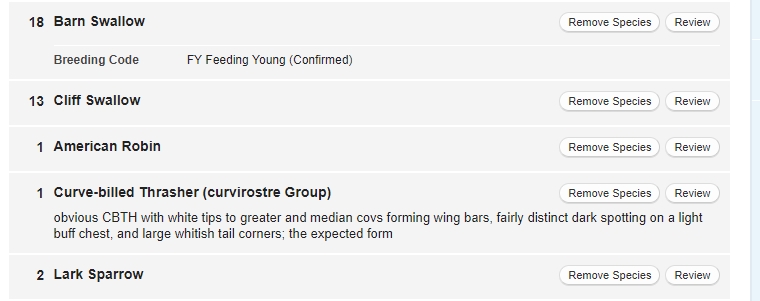
    As I wrote, one can put nearly whatever one wishes in that box.  What eBird reviewers wish, however, is that more eBirders would use that box to provide details on how that bird or those birds were identified or at how the reported number was arrived?  For species that the local filter considers rare, provide details on features that were noted that enable identification, with the amount of detail proportional to the level of rarity.  Perhaps more importantly, provide notes on what features were noted that rule out other, similar-appearing species.  [See an article about just such.]  For entries that are flagged due to a high number, a simple comment on how the number was derived is what we want:  "counted 1x1," "counted by 10s," or "estimate" usually suffice.

    For minor rarities or slightly out-of-season birds, a sentence or sentence fragment listing the aspects of the bird seen/heard may be all that is needed (e.g., "red, crested bird with black mask," "large bird of prey... white head and tail, dark brown body," or "long, slow, wolf whistle coming from above ground").  Indeed, for most entries that the relevant eBird filter flags, causing you to have to confirm your entry, such examples are often all that the local reviewer would need to allow the report into the public database.  For rarer events or trickier IDs, more details on the bird or birds' identification would be needed (Fig. 3).  If one has a photo or photos and if one is entering the data via the eBird app, then providing the comment "photo" or "I have photos" is fine as a place-holder, but not as a final comment.  If one has photos, please upload them using the "Media" tab (Fig 2).


    Figure 3. Reviewer-useful comments on a species that is only slightly rare, but is a somewhat-tricky subspecies identification.
    For even rarer occurrences, be prepared to provide quite a lot of information in this box, preferably with a photo or photos and/or audio files added to the species entry via the "Media" tab (Fig 2; also see this Eastern Meadowlark example).

    Particularly if one is reporting a checklist using the eBird app, putting the comment in that you have a photo or photos is fine, as long as one soon thereafter uploads the photo into the checklist.

    So, why do this?  The easiest answer to that question is that it will save time in the long run.  Any flagged entry is liable to be queried by the local reviewer.  Why wait?  Why have to go through the query-response cycle (or the query-response-query-response, etc. cycle)?  Providing the information up front saves that local reviewer time, effort, and, possibly, annoyance.  It is a good thing to do in the care and feeding of your local eBird reviewer.

    Finally, some observers question why a particular report is flagged and use the comments box to post it.  This is fine.  However, some of us have spent a LOT of time fine-tuning the filters that govern what is flagged and where, and being rude about that query is not at all helpful.  Instead of terse comments such as "not rare," something like "Could you explain why this entry is flagged?"  Except in a few filters in Colorado and Wyoming that have not seen a lot of work in recent years, there is good rationale behind the various filter limits.  We suggest that you check previous posts on this blog, as your question may have been answered there.

    Tony Leukering, Scott Somershoe, Steve Mlodinow, and Kathy Mihm Dunning


    Friday, March 18, 2016

    eBird checklists and miles traveled

    One of the tasks that eBird reviewers find difficult is dealing with checklists that involve long, traveling counts.  Such checklists often stand out because they tend to rack up relatively large numbers of individual species, thus tickling the relevant filter and getting particular species entries flagged.  However, a large percentage of such checklists have no flags, thus do not see review until and unless a reviewer goes searching for anomalous eBird locations of habitat-restricted species, such as, say, White-tailed Ptarmigan.  In fact, these habitat- and range-restricted species are the primary argument for having checklists with as precise a location as possible, else the resultant eBird maps show occurrence in areas or habitats in which the species does not occur.

    Unfortunately, the most comprehensive treatment of the subject is not that comprehensive and does not provide any hard-and-fast ground rules.  Granted, hard-and-fast rules when dealing with biology are nearly impossible, but eBird does care, and care strongly, about checklist locations.  In fact, I'm sure that if it were possible, eBird would prefer a checklist and associated precise location for every individual bird.  Of course, that is not going to happen, at least, not anytime soon.  However impossible the every-bird-is-its-own-checklist pipe dream might be, there are definite and very strong advantages to eBird of having checklists cover as little distance as we can get from eBirders.

    The best guidance that I have found in the eBird 'Help' tab is the "Traveling Counts" section of a general-purpose essay on making checklists more useful:


    Traveling counts have proven to be the most effective type of observation for modeling bird populations at large scales.  By doing these counts, birders often detect a good proportion of the birds in a given habitat.  It is critical, however, that your traveling counts not be too long.  Our analysts are able to effectively use traveling counts that are ≤5 miles [emphasis added].  Most birding that is conducted on foot easily falls within this window, but traveling counts by car can often be longer.  Please consider breaking up your long traveling counts into shorter-distance ones. It's best if these shorter counts are in a relatively consistent habitat, or do not pass through habitats that are too different. For example, a logical point to break a longer route into segments would be a transition between forest and farmland, as the birds found in these two habitat types are vastly different. Doing so would make information associated with each location — such as vegetation information from satellite images — more informative.  Plot your location at the center of the area traveled, not at the start point or end point.  It's okay to stop and spend time searching flocks of birds more thoroughly on traveling counts, as we are not assuming that you are traveling at a constant speed.  You're birding after all!
    I here note that eBird Central has repeatedly stressed that this "five-mile limit" should NOT be considered cause, in and of itself, for checklist invalidation, that the limit is simply one that is very useful in particular types of analyses, such as the STEM maps of migration of individual species.  Checklists covering trips of a reasonable longer distance are certainly permitted in eBird and most such provide perfectly valid and useful data.  The problem that eBird reviewers face is where to draw the line on "reasonable."

    Certainly, any eBirder should recognize that a checklist covering 650 miles on I-80 and crossing a state boundary (possibly, multiple state boundaries) and who knows now many dozens of county boundaries, does not provide data useful to anyone other than the observer.  In fact, such would provide misleading information, as almost no matter where such a checklist were plotted, the list of birds could well include species not regularly found at or near the plotted location.  But where lies the "reasonable" cutoff between 650 miles and five miles?  Unfortunately, this illusory line is dependent upon where you are and what sort of areas are covered by the checklist.

    In much of the flatlands of Wyoming and Colorado, a checklist covering 15 miles might include just one or two habitats (e. g., native grassland and winter-wheat fields) that share a large proportion of bird species present in the area, and thus provide reasonable eBird data.  However, in places like southwestern Huerfano County, Colorado, traveling on the road from Highway 12 toward Trinchera Peak -- the straight-line distance of which is just over 4 miles (though the road distance is a fair bit longer) -- one's elevation changes from roughly 9250 feet to over 12,100 feet.  This road takes one from about the upper limit of elevational range of species like Pygmy Nuthatch and Black-headed Grosbeak and the lower elevational limit of Gray Jay and Pine Grosbeak to the above-timberline habitat of White-tailed Ptarmigan and American Pipit.  Thus, any checklist covering the whole road will, perforce, require plotting some of the birds encountered in habitat different from that in which they typically occur.

    The above brings us back to the aforementioned eBird guideline about traveling distance and its emphasis on habitat.  Though not stated precisely in the guideline, eBird is very much interested in checklist locations being fairly specific to the habitats of the species included on the checklist.  Thus, in areas of the two-state region in which many habitats meet and mingle -- particularly obviously differing habitats, such as grassland and woodland or conifer forest and alpine tundra, the more precisely that locations are plotted and the shorter distances that are covered by individual checklists the better.  With the eBird application (app) for smart phones (about which, please read the best-practices essay), this becomes quite easy to manage.  Granted, cell coverage in much of the two states leaves much to be desired, but there is a simple work-around when planning a trip to an area of poor cell coverage.  One can modify this technique when already out and unexpectedly (or otherwise) run into poor cell reception, by using an existing checklist in the app on which to base the new one.  It is important to remember in such cases that county boundaries are often filter-region boundaries and species that are expected in some counties (thus, not flagged by occurrence, alone) may be unusual in a neighboring county, which may cause some slight disconnects between what species one sees and the "allowable" list of species on the current active checklist on the app.

    Most eBirders understand the need to separate sightings in one county from those in another into different checklists.  While this is less of a problem in Wyoming than it is in Colorado (mostly due to the many fewer counties in Wyoming), both states host birding locations that cross county borders, with Yellowstone N. P. being the mother of all examples in the two-state region (heck, the Park even straddles multiple state borders!).  In Colorado, particular problem children birding sites include Chatfield S. P., Jumbo Reservoir, and Comanche N. G.  However, the single most-recalcitrant problem child is the area around Denver International Airport (DIA).

    The DIA problem was created when the airport was first proposed, because Denver County was allowed to annex a sizable chunk of what was then Adams County in order to build the airport and the access road (Peña Boulevard). This action created a long, snaking corridor of Denver cutting through Adams.  Were it not for Denver County's small size and its near-complete lack of native habitat, the DIA problem would not be a problem.  However, with birders' interest in county listing, this long snake of a Denver extension travels through some excellent habitat otherwise lacking in the county and providing access to species that have been extirpated from the original county boundary... such as Burrowing Owl.  The whole eBird-review problem here is based on the fact that this corridor of Denver is so narrow, just 1.3 miles wide at its narrowest, thus it is nearly impossible on a birding jaunt of the area to not cross into and out of Adams County, sometimes multiple times.  This all means that most (if not nearly all) eBird checklists submitted from the DIA environs cover an area claimed by multiple counties, something that is not "permissible" in eBird.

    In summary, I provide what I think are some reasonable guidelines on when to end the current eBird checklist and start a new one.
    • When a state boundary is crossed
    • When a county boundary is crossed
    • When crossing an obvious boundary between open habitat and wooded or forested habitat
    • When arriving at a birding location (particularly one that is an eBird hotspot) that has well defined borders and that is managed by a particular government agency or non-governmental organization (e. g., a state park, a national wildlife refuge, a private preserve)
    • When leaving a birding location (particularly one that is an eBird hotspot) that has well defined borders and that is managed by a particular government agency or non-governmental organization (e. g., a state park, a national wildlife refuge, a private preserve)
    • When leaving the "understood" area of an eBird hotspot, even if that hotspot lacks well defined borders (e. g., "Yellowstone NP--Midway Geyser Basin" or "Rocky Mountain NP--Endovalley")
    • When accruing 15 miles of distance in relatively homogeneous habitat in open country (such as in sage shrubsteppe, grassland, agriculture)
    • When accruing 5 miles of distance in relatively homogeneous forested habitat without significant (≤750 feet) elevational change
    • When accruing 2 miles of distance when encountering relatively significant elevational change (>750 feet, ≤1500 feet)
    • When accruing 1 mile of distance when encountering significant elevational change (>1500 feet)
    • When accruing two hours of observation (one hour would be even better)

    Sunday, February 21, 2016

    Update on Colorado and Wyoming filters

    It has been more than long enough for another post on this venue, and I apologize for that for myself and the rest of the two states' eBird reviewers.  Personally, long work days and many other writing commitments can be blamed.  Of course, if I didn't go birding, I'd have more time to write about birding.

    As I alluded in a previous post, eBird is interested in pursuing more and better habitat-based filter regions, rather than the current system of using geopolitical boundaries to define them.  As part and parcel of that interest, Don Jones (a member of the Wyoming review team) will be putting together a proposal for such for Wyoming as part of his undergraduate work (as the Brits would say) at university.  I have spent some time in designing such a system for Colorado, and have nearly completed a first-draft version for eastern Colorado.  Though Colorado's plains may seem to be easier to deal with in this regard than is the rest of the state, the reverse is actually true.  The extreme topography gradients in western Colorado actually preclude making small, tight filter regions (one would need 100s of the things!), so fairly large filter regions will still be the easiest way to treat that part of the state.  In eastern Colorado, however, there are numerous large reservoirs that attract a very different avifauna compared to most of the rest of the area.  In addition, the large urban area with their de rigeur tree canopy also make for very different bird habitat than found on the rest of the plains.  My current map has 26 regions defined from east of the Front Range-Wet Mountains-Sangre de Cristos Mountains line, where there are currently 20 regions, eight of which extend well up into the mountains.  eBird is not yet ready to greatly expand the number of "arbitrary polygons" used as filter-region boundaries, but when they are ready, Colorado and Wyoming will be ready, too.

    Since February 2015, I have split Cheyenne and Kiowa counties out of the former Southeast Region into their own regions, bringing us to 39 current Colorado eBird filter regions, and with the Southeast Region no longer named such, as the remaining multi-county region is now titled Bent and Prowers.  I had plans to split those last two counties, but have decided to spend the necessary time on designing arbitrary polygons, instead, which will (hopefully soon) negate any effort to make individual filters specific to Bent and Prowers counties.

    Finally, I continue to fine tune existing filters, which may cause some to many data that may have resided comfortably in eBird for years to suddenly get flagged.  Please do not be alarmed when you receive a request from one of us regarding a sighting from last year or from five years ago.  This is a normal process, one that is greatly aided by the great increase in amount of eBird data available to analyze how filters might be made more precise.  That is, thanks to you, eBird becomes stronger and stronger in its ability to define geographic and temporal bird occurrence in Colorado and Wyoming and the rest of the world.

    Thursday, February 26, 2015

    Stone Age to Industrial Age: The evolution of eBird's filter system

    Did you ever wonder why eBird asks for details about a report of American Dipper from Adams County, Colorado, but lets the same report from Park County, Wyoming, sail through without a twitch? I just want to say one word to you; just one word... "filters."

    A filter is what creates the list of species (and non-species entries) that you see when you enter a checklist into eBird. Imagine, with the current world-wide scope of eBird, having to rummage through the entire list of the world's 10,000± species of birds just to enter the seven species that you saw in a nine-minute jaunt through your yard. Ugh. No one would use eBird. Thus, filters were created from the program's inception in order to streamline the data-entry process.

    Filters have at least a couple other purposes, which go hand in hand with the primary purpose. The first of these is to call attention to the eBirder entering data that a species is not expected at the location, which helps point out possible data-entry errors. I've done it; you've done it. You meant to enter an American Bittern, but you got the number in the box for Least Bittern. Oops. eBird will point that out to you when it asks you to confirm the entry, as the species is rare in this region. Filters also involve abundance limits, which, again, enables the software to point out possible data-entry errors. This one I've done numerous times with my fat fingers. You meant to enter 1 American Bittern, but you accidentally also hit the zero on the number pad resulting in 10 American Bitterns. With the filter set at something less than 10, eBird will point out that error when it asks you to confirm the number, which is atypical for anywhere in this region.

    In the beginning (2002), eBird was a very simple and simplistic world. The first iterations of filters were state-/province-based things (the program was originally restricted to the U.S. and Canada) that provided gross estimates of numbers acceptable for that state in each of the 12 months of the calendar. They were created as Excel spreadsheets, with species down and months across, each cell filled with an integer that was a gross approximation of what was thought to be the realistic maximum that one might encounter in a day's birding in the state/province; no matter where in the state/province. Abundant species, such as Red-winged Blackbird, might have a cell (or each of the 12 cells) filled with 100,000.

    Chris Wood (currently the eBird Project Manager, but then "just" a Colorado birder with a strong knowledge of the state's bird distribution) and I constructed the first Colorado filter in 2001 and we did not really think through the ramifications of those cell entries. We did not consider data-entry errors. We did not consider what those cell entries might mean regarding permitting some fairly outlandish numbers to skip the review process. At the time, there were no non-species entries. That is, no spuhs, slashes, hybrids, subspecies. There were just species.

    As eBird has become more refined with much more capacity and capability (thanks to Jeff Gerbracht and the rest of eBird's architect team), filters have become incredibly more complex. First, was the separation of the statewide filter into regional filters, using the county as the basic block, at least in the Lower 48. Circa 2005, Chris and I divided Colorado's statewide filter into five regional filters in which we lumped counties with similar avifauna: Northeast, Southeast, Mountains, Northwest, and Southwest. That, obviously, required some fine-tuning of each of those five filters to more-closely match each subregion's avifauna, such as excluding Northern Bobwhite from the three western filters and excluding Gunnison Sage-Grouse from the two eastern filters and the Northwest filter.

    Next was the addition of various above-species-level entries, the spuhs (e. g., "goose sp.") and the slashes (e. g., "Semipalmated/Western Sandpiper"). That meant going through each of the five then-extant filters and adding those non-species entries relevant to each filter, which I did (Chris was now working at eBird) on a fairly conservative basis, putting in just the really common non-specific entries, such as "Snow/Ross's Goose" and "accipiter sp." That wasn't too bad. Tedious, but not too bad, and at the time, I was the only person working on Colorado's eBird filters. Due to Wyoming's low human population (thus birder population), the state did not then have a resident filter meister; the Stone Age (statewide) filter was established and maintained at eBird Central at the Cornell Lab of Ornithology.

    At some point after the addition of non-species-level entries, I started splitting the five Colorado filter regions into smaller ones in order to account for the complexity of bird distribution in the state, such as taking the species-rich and well-birded counties of Boulder and Larimer out of the northeastern filter and constructing a new filter that could be more tightly focused on that smaller region's avifauna. With available time, the number of Colorado filter regions grew, cracking double digits and never looking back.

    In 2007, the addition of Marshall Iliff as the third member of the eBird management team (Team eBird; Brian Sullivan and Chris Wood being the other two), eBird's abilities expanded further, with a more-in-depth taxonomy that was to cover the entire planet (2010). (I find it very interesting that Brian, Chris, and Marshall all worked for me at Rocky Mountain Bird Observatory at various times and that all worked on the same project in Mexico with me one year!) Hybrids were added, as were many, many, many more non-species entries, such that there are now nearly as many non-species-level entries available in the ABA area as species-level entries, some used exceedingly rarely, some widely used.

    Then, eBird tackled the "April problem." Those of us in the filter and record-review aspects of eBird had for years complained that the rigid monthly structure to the filters made for some major problems, with April being the poster child for such problems. In much of the ABA area, particularly the Lower 48, filter makers/editors had to decide between filtering out all occurrences of a migrant species that arrived in the filter region in the last few days of April, or allow all occurrences in the month of such species, even in early April when they were unknown. In Colorado, MacGillivray's Warbler is an excellent case in point, with the vast bulk of migrants arriving in May, but with a small number typically noted in the last week of April, but unknown in the state prior to the 22nd or so.

    The solution was to throw out the monthly framework, replacing it with up to 13 individually adjustable time periods. The new system allowed chopping up, particularly, the short, intense spring migration of most migrant species into periods as small as five days, with each period allowed its own abundance limit (a number that is "permitted," with any larger number of birds of that species in that time period requiring review). As example, the Lincoln County, Colorado, filter has five filter periods covering the spring migration of Clay-colored Sparrow, each with its own abundance limit (in parentheses): 22-30 April (1), 1-7 May (9), 8-14 May (29), 15-21 May (15), and 22-31 May (9). The filters are also now constructed online, a move nearly enforced by the new system (Fig. 1); think about trying to construct an Excel spreadsheet that does this.


    Figure 1. Abundance and seasonal limits of a variety of sparrow species (and non-species entries), January through about 15 August in Lincoln County, Colorado, as indicated by the current eBird filter for that county. Click on image to see larger version. Note that the short lengths of some of the temporal periods of the filter mean that values of more than one digit are partially hidden by the scroll arrows in each period (see Clay-colored Sparrow). Note that there are three non-species entries, two subspecies of Brewer's Sparrow (neither of which is allowed without review, as identification is quite difficult) and a spuh (Spizella sp.). One can quickly determine from this filter those species of this selection that are known to breed in the county, just Cassin's and Vesper sparrows. Note also that the individual abundance limits of the spuh entry allow for all temporally-occurring species of the genus, as it is fairly easy to imagine most of a large flock of mixed Spizella not being identified to species. Finally, the grayed '+' buttons indicate entries (Chipping Sparrow, Clay-colored Sparrow, Spizella sp.) for which all of the possible 13 temporal periods are used; that is, the occurrence patterns represented in the filter cannot be further divided.

    As something of an aside, an abundance limit is the result of a decision about a tenuous balance between the number that might occur and catching data-entry errors, and such decisions need to be made for as many as 13 temporal periods for each of the species and non-species entries in each filter (the current Boulder County, Colorado, filter -- split off from the Boulder/Larimer filter a few years back -- lists 413 species and 231 non-species entries).

    While the new filter system allows great flexibility in constructing species- and location-specific filter limits, it is also much more complex and much more time-consuming to construct. It takes me something like 5-20 hours of tedious effort per filter, whether constructing a new filter from scratch or completely overhauling an existing filter.

    In the early years of this decade, big changes came about in the Wyoming birding community and in Wyoming eBird review and filters. First, Shawn Billerman arrived to attend to graduate studies at University of Wyoming. Before arrival, though, he had already been shanghaied by Team eBird (he did come straight from school at Cornell, so was already known by the powers-that-be) into tackling the state's eBird review. James Maley arrived a year later (working at University of Wyoming) and was quickly added to what was then a two-person team. Perhaps more importantly, though, they took on the task of bringing Wyoming eBird into the Industrial Age, as far as filters go. They divided the statewide filter into seven filter regions (Fig. 2).

    Figure 2. The seven Wyoming filter regions.

    Meanwhile, Colorado, with its considerably more-substantial eBird data set (and, perhaps, a filter meister with a wee bit more time on his hands), has 37 filter regions. As depicted in Figure 3, these regions are, generally, individual counties, though with a few two-county regions. The large, multi-county regions are in the process of being broken up into smaller units, with the Southeast region being an excellent example. Just in late February 2015, I have split the old large and unwieldy version of the Southeast filter into three regions: Baca, Crowley and Otero, and the rest of the counties. The San Luis Valley region, though large, is fairly homogeneous, so will not be broken up into smaller regions until some rather major changes in how eBird deals with filter regions come to pass (see below).

    Figure 3. The 37 Colorado filter regions.

    As it always has been, the primary impetus to establish a new filter region is to fine-tune filters to the landscape and the avifaunal occurrence (both spatial and temporal) thereon. Perhaps one of the best examples of the need for such new filters is Phillips County, Colorado (Fig. 3). At the time that I constructed the filter, the county was covered by the general Northeast filter (which also included Weld at the time). Note that all of those counties but Phillips has at least part of a major water body in it, while the largest water body in Phillips is probably a sewage pond (at Haxtun). Thus, Phillips County data were "allowed" to include large numbers of waterbird species that are actually fairly rare there.

    However, just because a particular filter covers just one county does not mean that there aren't still difficult decisions about filtering to be made, and Wyoming is the epitome of that problem. Because of the state's low human population, its counties are overly large. The state's geography is also more varied and, well, eccentric. The combination of these two factors means that, unlike eastern Colorado, most of Wyoming's counties contain both low-elevation "flat" lands and high mountains, which makes for a wonderfully varied avifauna from a birding standpoint, but a nightmare from an eBird-filter point of view.

    One of the best examples of this problem is Big Horn County, which combines the spine of the Big Horn Mountains (and the associated suite of subalpine forest species) and the low-elevation Big Horn Basin (and the associated grassland and shrubsteppe species). Because one would not expect to encounter Long-billed Curlew in the forest near the pinnacle of the Big Horn Mountains nor White-winged Crossbill in the open country northeast of Greybull, eBird really should not "allow" such occurrences. However, with county-based filter regions, such problems are encountered frequently. In the long term, the solution is filter regions based on physiognomy and habitat, not geopolitical boundaries -- what we might term Space Age filters. Though there have been arbitrarily defined filter regions in the past (e. g., most or all of the California coastal counties have "offshore" regions), Team eBird is moving in that direction in a general fashion. However, the process will be long, involved, and tedious, and will not happen tomorrow.

    As more and more data are entered into eBird, the data sets for individual filter regions become more robust and allow for more-precise filter limits and temporal periods, so reviewers are constantly fine-tuning filters. However, as noted above, this is a slow process. Thus, you may encounter remnants of previous filter strategies mixed with more-"modern" strategies on individual filters in both states when entering data into eBird, simply because no one has found the free time to completely revamp older filters. So, when you encounter something that a filter flags that you believe should not be flagged, please let us know (politely!) in the species's comment field. That goes the same for occurrences that you feel ought to be flagged, but aren't. Most of you know your local area much better than any of us do; we're happy to learn such bits of information, particularly in Wyoming, which has many fewer data backing the various filters.

    As eBird continues to grow in popularity, demands on its programming, design, and operations will also grow. With the very recent addition of Ian Davies to the management team and the resultant spreading of the workload at eBird Central, we can expect further enhancements, even radically new capability, to come online in the near-term future. I cannot wait to see the changes!

    [This essay is largely based on a previous version that I posted to Cobirds, the Colorado birds listserve. Thanks to Team eBird and various members of the Colorado and Wyoming review teams for comments on an earlier version of this essay.]

    Tony Leukering

    Lead Colorado eBird reviewer and senior author of the Colorado & Wyoming column in North American Birds

    Wednesday, February 18, 2015

    The Colorado and Wyoming eBird blog, a new era for eBirders in the region

    Welcome to the first post in a new blog that is focused on eBird in Colorado and Wyoming. If you wandered here and found yourself wondering, "What the heck is eBird," then you might want to check it out. The eBird review teams of the two states mean for this to be a way to impart information about all aspects of the eBird review process to the region's eBirders, with its primary purpose of making the review system at least translucent. There will be essays on how eBird filters work, how they are created, and what they mean for your entry of data into eBird. However, there is a strong secondary purpose: to show eBirders how they can get more out of eBird and put more into eBird, through helpful hints on a variety of topics. Such may include essays on ways to make their data more meaningful from a scientific point of view, how to use eBird's output features to increase their knowledge and understanding of both spatial and temporal distribution, and when and how to use non-species entries, among a host of other possibilities.

    All of us are quite busy with eBird review and birding, in addition to all of those other things that "normal" people do (going to school, working, sleeping, lazing around putting jigsaw puzzles together), so this will not be a blog that's updated daily. Or even weekly. But, give us a bit of time and a few posts and then we'd be happy to tailor future essays to questions about or problems with eBird that you encounter. Realize, though, that there is an extensive FAQ (that's "frequently asked questions" for you analog dinosaurs like me out there) at eBird that may well be able to answer your question(s).

    Tony Leukering

    Lead Colorado eBird reviewer and senior author of the Colorado & Wyoming column in North American Birds