Showing posts with label high count. Show all posts

Friday, June 29, 2018

Providing details on flagged high counts of birds

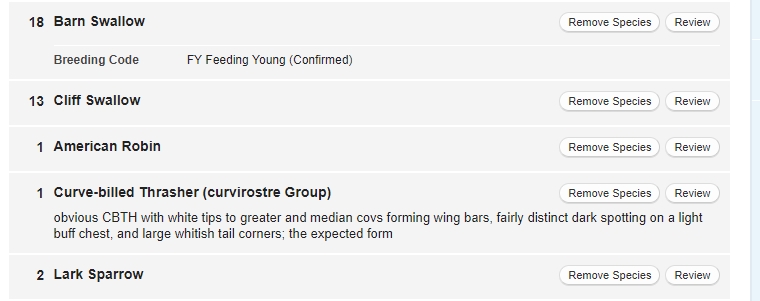
Home-page screen of the current iOs beta version of the eBird application (app). Click on image(s) to see larger versions.

In the beginning, the eBird app required users to provide details for any species that the relevant filter flagged as unusual, either due to the species' rarity or the count being higher than the filter limit, else the checklist would not submit. In 2017, eBird Central decided to dispense with the requirement for details on high counts in order to submit checklists, despite the moaning and gnashing of teeth by many eBird reviewers (including the entire Colorado contingent). This change was incorporated into the then-new Android version of the app and is in beta-testing mode in the iOs version. While both versions of the app still require written details in order to submit reports of rarities, reports from the Android version do not require details for non-zero counts exceeding the filter limit, and the iOs version is heading that way.

Many eBirders have probably rejoiced at this change, but we reviewers really dislike it. That is because a large percentage (though still a minority) of reports in our eBird review queues have no details due to this change. That means that reviewer workload got substantially larger and for very little benefit to eBirders in general. Before the change, something like a simple "estimate" or "counted by 1s" or "counted a portion and extrapolated total" were all that we requested for reports of high counts. The primary reason that reviewers want those details is so that we can be sure that the number reported was the number intended. Even on a phone, it is possible to make a mistake (or series of mistakes) and report unintended numbers.


Because filter limits are kept fairly tight in much of Colorado and Wyoming, reviewers in this region already have a larger task than do many, so this extra workload of having to query observers for details on high counts can be the straw that broke the camel's back. That broken back might result in blanket movement of non-documented reports of counts greater than the filter limit into eBird's non-public data, and none of us -- eBirders or reviewers -- want that. So...


PLEASE REPORT DETAILS OF HOW ANY HIGH COUNTS WERE DERIVED. (Again, see here.)


For those that haven't studied how the new app versions look and act, below are some illustrated examples of what your app can show you and what we, as reviewers, would really like eBirders to do.


Figure 1. iOs beta version app showing a hypothetical checklist. Note that the Rock Pigeon tally is indicated as exceeding the filter limit (which is set at 39). Also note that the Inca Dove entry is of a species that has a filter limit for the date and location of zero or is not on the relevant filter at all (in fact, it is not on the filter, as there are no county records). In order to submit the checklist to eBird, the app will require comments for the Inca Dove. However, it will not require comments on the high count of Rock Pigeons. We repeat:  PLEASE REPORT DETAILS OF HOW ANY HIGH COUNTS WERE DERIVED.


Figure 2. Upon tapping on the Rock Pigeon entry in the checklist on the app (see Fig. 1), one can add the detail that we reviewers would like to see on how the high count was derived. We do not need a novella written, just a simple, brief description of your counting/estimating technique (here, "estimate").

Figure 3. Unlike for the Rock Pigeon high count (Fig. 2), rarities require a bit more text. Minor rarities or those entries of species that are only marginally early or late can be supported by skimpier details, but true rarities, like this Inca Dove, need to be supported by firm details. This example is just barely enough for validation, though the promised photos would obviously help a lot.


Figure 4. We reviewers, all being eBirders ourselves, know what a pain it is to have to type much more than a few words into the comments field. However, assuming that one follows through and provides those promised details and/or photos, simply letting us know that you understand why a species flagged and that you'll get to providing those critical details as soon as you can get to a more-typing-friendly machine serves as a useful placeholder. However, PLEASE PROVIDE THOSE DETAILS AND/OR PHOTOS AT YOUR EARLIEST POSSIBLE CONVENIENCE so that we do not have to spend the time querying you.

[A side note about numbers: If one counts a flock of birds by 10s, one cannot report 362 (even if one counted 360 and then two flew over later), as that number is not divisible by 10 without figures to the right of the decimal. It's kind of difficult to have 0.2 of a live bird. One also cannot "count by 5s, then 10s" and report 365, as one's total must be a multiple of the grossest sample size -- in this case, 10. Think of it like this: Before starting a road trip, you check your car odometer, which reads 26362. Upon arriving at your destination, you check it again and it reads 26398, yet you report to the friend that you are meeting that you drove 36.2 miles. The process of counting in smaller sets of birds is similar.]

Tony Leukering and Scott Somershoe (CO reviewers)

Wednesday, August 9, 2017

eBird basics: The species comments box

For every entry that one makes in eBird, you have the option to provide comments.  You can put whatever you want in the comment section.  However, for flagged reports, the information that is really needed are details that describe the bird and eliminate other species, or how you documented a high count, are needed. Why should you add such information? Providing the needed information up front saves the local reviewer time, effort, and, possibly, annoyance. You may also come to pay closer attention to details on uncommon and rare species, subsequently increasing your skill, and providing valuable information that's archived for people for years down the road.

Each species, subspecies, and undetermined entry has a comments box that is accessed by clicking on the "Add Details" button to the right of the species (or other entry) name (Fig. 1).

Figure 1. The "Add Details" button that leads to the species-comments box (see below).

Clicking on that button leads to opening what eBird calls the "Details" box (Fig. 2).  It is intended as a place to put comments on the species (etc.) that one is reporting.
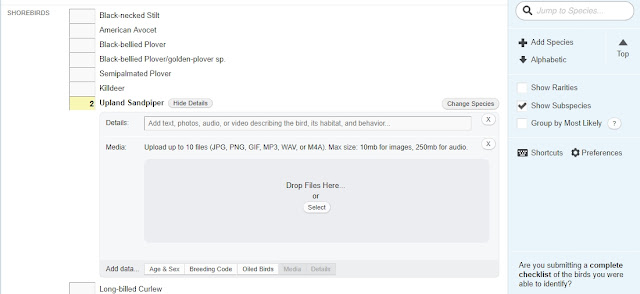
Figure 2. The opened species-comment box. Other useful features shown in this figure include the "Show Rarities" box (check it if the species you wish to report is not on the checklist) and the "Add species" link if that species still does not show after checking the "Show Rarities" box.
One can add most anything to this box that one wishes; it sees a lot of use.  Such comments, are varied and "include things like "Life bird #263;" "bird was visiting the right-most feeder in the back yard;" "I would not have seen it if it weren't for the ball game being pre-empted;" or "in a tree."

As I wrote, one can put nearly whatever one wishes in that box.  What eBird reviewers wish, however, is that more eBirders would use that box to provide details on how that bird or those birds were identified or at how the reported number was arrived?  For species that the local filter considers rare, provide details on features that were noted that enable identification, with the amount of detail proportional to the level of rarity.  Perhaps more importantly, provide notes on what features were noted that rule out other, similar-appearing species.  [See an article about just such.]  For entries that are flagged due to a high number, a simple comment on how the number was derived is what we want:  "counted 1x1," "counted by 10s," or "estimate" usually suffice.

For minor rarities or slightly out-of-season birds, a sentence or sentence fragment listing the aspects of the bird seen/heard may be all that is needed (e.g., "red, crested bird with black mask," "large bird of prey... white head and tail, dark brown body," or "long, slow, wolf whistle coming from above ground").  Indeed, for most entries that the relevant eBird filter flags, causing you to have to confirm your entry, such examples are often all that the local reviewer would need to allow the report into the public database.  For rarer events or trickier IDs, more details on the bird or birds' identification would be needed (Fig. 3).  If one has a photo or photos and if one is entering the data via the eBird app, then providing the comment "photo" or "I have photos" is fine as a place-holder, but not as a final comment.  If one has photos, please upload them using the "Media" tab (Fig 2).


Figure 3. Reviewer-useful comments on a species that is only slightly rare, but is a somewhat-tricky subspecies identification.
For even rarer occurrences, be prepared to provide quite a lot of information in this box, preferably with a photo or photos and/or audio files added to the species entry via the "Media" tab (Fig 2; also see this Eastern Meadowlark example).

Particularly if one is reporting a checklist using the eBird app, putting the comment in that you have a photo or photos is fine, as long as one soon thereafter uploads the photo into the checklist.

So, why do this?  The easiest answer to that question is that it will save time in the long run.  Any flagged entry is liable to be queried by the local reviewer.  Why wait?  Why have to go through the query-response cycle (or the query-response-query-response, etc. cycle)?  Providing the information up front saves that local reviewer time, effort, and, possibly, annoyance.  It is a good thing to do in the care and feeding of your local eBird reviewer.

Finally, some observers question why a particular report is flagged and use the comments box to post it.  This is fine.  However, some of us have spent a LOT of time fine-tuning the filters that govern what is flagged and where, and being rude about that query is not at all helpful.  Instead of terse comments such as "not rare," something like "Could you explain why this entry is flagged?"  Except in a few filters in Colorado and Wyoming that have not seen a lot of work in recent years, there is good rationale behind the various filter limits.  We suggest that you check previous posts on this blog, as your question may have been answered there.

Tony Leukering, Scott Somershoe, Steve Mlodinow, and Kathy Mihm Dunning